In partnership with


Who Else Were They Supposed to Interview?
TwinSpires celebrated a 12-race winning streak and got an earful about the trainer. So we went and read the rulings on racing's 25 leading barns. Almost everyone has one. Working out which ones matter is the hard part.
TL;DR
TwinSpires probably could've interviewed just about any top trainer and found someone with a disciplinary record. We found sanctions involving at least 23 of the top 25 trainers by earnings. But there's a big difference between getting fined $25 for missing silks and getting suspended 100 days over 12 medication positives. Ness isn't exactly the hill we'd choose to die on, but the bigger problem is a sport where disciplinary records are so common, and so difficult to untangle, that nobody knows where to draw the line.

Last Saturday at Churchill Downs, a horse claimed for $7,500 in March named Kerness K won the Claiming Crown Ready's Rocket Express. It was his 12th win in a row, 11 of them for trainer Jamie Ness. That is the kind of streak that makes us question every ticket we've ever torn up.
TwinSpires did what any racing account would do. It posted a clip inviting everyone to watch the race alongside Ness. He stands at the rail and watches the stretch run the way we watch the last leg of a Pick 5, except his horse actually gets there, and he ends up laughing.
The replies were not about the horse. They quickly turned into a discussion of Ness's disciplinary history. The gist: of all the people to put on camera, him?
Which got us wondering. Fine. Who else?
We Took the Question Literally
We pulled the 25 leading North American trainers by 2026 earnings and went looking for every final ruling against them we could find: state commission sites, the federal HISA portal, court decisions, and The Jockey Club's rulings database, which made us tick three boxes and promise to behave.
Here is the scandal-sized number. At least 23 of the 25 have at least one documented final sanction somewhere on their record.
Twenty-three. If TwinSpires wanted a top trainer with a spotless file, the casting call was going to be short.
But notice what that number is. It counts trainers, not violations. Some states publish every $25 fine and others publish next to nothing, so adding up totals mostly tells you where a barn races. And "has a ruling" turns out to cover a lot of ground.
A $25 Fine Is Not a 100-Day Suspension
Start with Ness himself. His record includes a 2017 Florida consent order covering 12 positives for clenbuterol, a regulated medication, in races from late 2012 to early 2014. The penalty was a 100-day suspension and a $4,800 fine. In the order he "neither admits nor denies" the violations, though he was blunter with Daily Racing Form at the time: "It's nobody's fault but my own."
That is a serious penalty, and the people in the replies were not making it up.
His record also includes 33 Maryland stewards' rulings, like this one, for not having the owner's silks in the jockeys' room on time. The fines ran from $25 to $100. In a raw count of disciplinary incidents, each missing-silks fine gets one entry, just like the case that resulted in a 100-day suspension. We have lost more than that on a single exacta box and nobody suspended us, although several people have suggested it.
And then there is Pennsylvania. In 2022, Parx stewards handed Ness a six-month suspension over a positive test. In March 2023 the state commission rescinded the whole thing, as BloodHorse reported. An overturned ruling is not a violation. It will still follow him around the internet forever.
The Morning Line on a Suspension
It gets stranger when you look at how the big penalties actually land.
In 2012, California's racing board suspended Doug O'Neill for 180 days over a horse whose blood test came back above the carbon dioxide limit. The final settlement required 40 days. Racing may be the only sport where the suspension has a morning line and then drifts.
Or take Linda Rice. New York's Gaming Commission ordered her license revoked in 2021 in a case about improper access to race-entry information. It was not a drug case at all. An appeals court upheld the finding but threw out the revocation, and the commission ultimately imposed a $100,000 fine. So is that a "revoked license" on her record, or a fine? Depends which document you stopped reading at.
When we drew a higher bar of our own, counting only suspensions of more than 30 days that the final order actually required, or fines of $25,000 and up, the 23 shrinks to seven of 25. That threshold is our editorial judgment, not a category any regulator uses, and it says nothing about intent. Most of those cases are medication overages decided under rules that hold the trainer responsible whether or not anyone meant anything. An overage is not automatically doping, and our line does not pretend to measure the difference.
Our Hot Take: TwinSpires Is Not the Problem
Let's be fair to the people holding the camera. TwinSpires was celebrating a horse who had won 12 straight, which is the best story on any card. Showing the winning trainer is not an endorsement of his file from 2017. By its own posts, it also caught up with at least two other winning trainers that day.
(A small aside: the post called Kerness K Ness's first Churchill Downs starter. Equibase lists two for him there in 2010. Records are hard. Ask us how we know.)
The real problem is bigger than one clip. The records are public, technically. They are also scattered across dozens of state sites, a federal portal, a private database and the occasional court opinion. Reversals often don't get attached to the rulings they reverse. It took us days and an alarming number of browser tabs to sort out 25 trainers, and we still say "at least" before every number.
A horseplayer deciding whether to trust a barn gets a reply section instead. And without doing the homework, it is very easy to lump a late-silks fine in with a 100-day suspension, or a pending case in with a finding, because the sport has never made the difference easy to see.
So who else were they supposed to interview? There were other options. Nine trainers won a Claiming Crown race that day, and for a few of them we found no sanctions at all, which is not a clean bill of health but is not nothing. Not every record looks alike, and that is the point. The trouble is that a bettor has no easy way to tell a minor infraction from consequential misconduct. What the sport needs is one place to look up a trainer and see what happened, what it was for, and how it ended.
Here is the absurd part. It takes about a minute and a half to watch Kerness K win his 12th straight. It took us days to work out what his trainer's record actually says. Until that gap closes, we'll keep reading the PDFs so you don't have to. We understood roughly 60 percent of them.
This review is based on publicly available regulatory records and reporting. We did not seek comment from the individuals or organizations mentioned. Our findings reflect the records we could locate, not an exhaustive accounting of every ruling ever issued.

Who Lets Go of a Horse on Purpose?

Stewards at Delaware Park have taken away an exercise rider's license and fined him $500 after, according to the ruling, he got off a horse during training hours and deliberately turned it loose on the track. The rider is identified only as Vargas. The horse and trainer have not been named.
The horse was seen by a veterinarian afterward, and steward Crane went to check on it. The rider can still apply for other Delaware licenses, such as groom or hotwalker.
It could have been very bad, a lot worse than it was.
Read the full story from Paulick Report here.
Hotwalker remains on the table, a job where the entire description is "hold on to the horse."

Racing NSW Investigates Handling of So You Are's Remains

So You Are, the 5-year-old gelding who finished eighth in the Melbourne Cup on Nov. 3, died after a severe bout of colic, trainer Bjorn Baker said Monday. He was taken to an equine hospital in Sydney and euthanized after emergency treatment.
A day later, The Sydney Morning Herald reported that a construction worker had filmed the horse's body in a dumpster at a licensed waste facility and posted the video online. The veterinary practice said a contracted service collected the body and took it to a landfill, where it was moved into a skip bin.
Racing NSW is investigating and called the way the body was left "distressing and completely unacceptable." It said the body was being held temporarily ahead of burial when the video was taken. Industry guidelines, which list a licensed landfill as the preferred option for euthanized animals, are under review.
Read the full report from CBS News here.

How Do You Keep the Farm and Lose the Dynasty?
This week's watch is the story of Claiborne Farm: three thousand acres of Bourbon County limestone on the Winchester Road outside Paris, Ky., in one family since 1910. Nasrullah, Bold Ruler and Round Table stood in the same low shed row. Between 1930 and 1993, a Claiborne stallion led the American sire list 28 times, including 15 years in a row. Secretariat stood in the first stall and is buried behind the office.
Then Bull Hancock died in September 1972, and his will named no heir. The decision went to three men outside the family, who passed over his 29-year-old son for the 23-year-old. Five months later, the younger son syndicated Secretariat for $6.08 million.
The elder, Arthur Hancock III, built Stone Farm six miles away and won the Kentucky Derby his father never did, beating Claiborne-raised Easy Goer with Sunday Silence in 1989. Danzig led the sire list in 1993. No Claiborne stallion has led it since.
The farm is still there, still in the family and has never been sold. The film asks how a dynasty can keep everything it owns and still lose what made it matter.
Watch the full documentary here.
Passed over at 29, then beats the family farm in the Derby. We have held grudges over far less and won nothing.
Rail Chatter
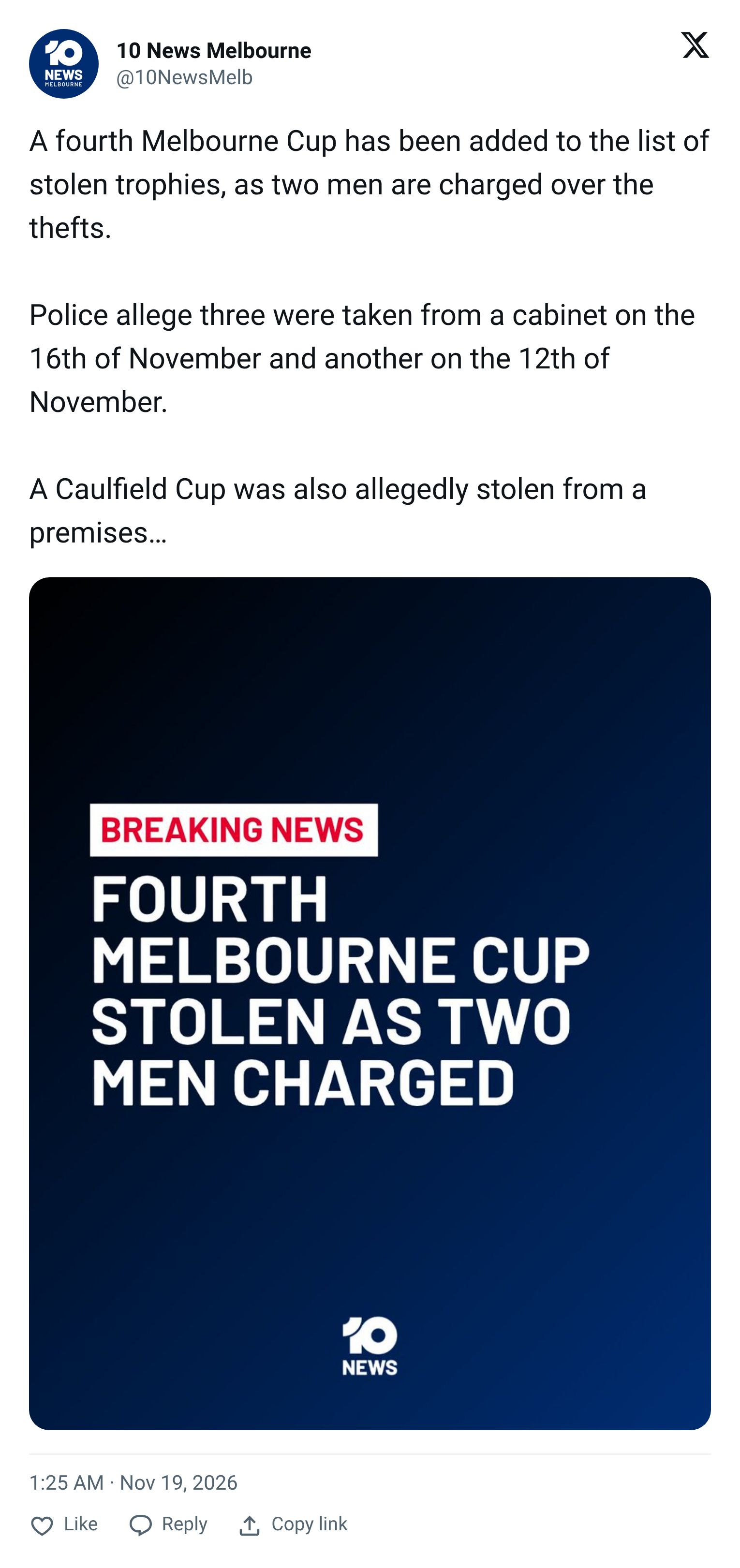
Three things racing Twitter was talking about this week while we were reading stewards' rulings.
@10NewsMelb reports that a fourth Melbourne Cup has been added to the list of stolen trophies, with two men now charged. Three of them are Makybe Diva's. Victoria Police allege two men smashed a display cabinet at Flemington at about 6:30 a.m. Monday and left with all three, valued at roughly A$1 million apiece. Somebody finally hit the Cup trifecta cold.
@DRFHersh has had enough of how major tracks are filming races. His request is modest: show the horses in a homestretch pan and film the gallop-out properly. We would add more: cut down some of the trees at some of these tracks (we won't name names).
@EMD4CT says they watched $123,000 land in a pool as the last horse loaded and another $400,000 arrive mid-race, and blames the computer teams. We can't check the numbers, but anyone who has watched 5-1 become 5-2 on the backstretch knows the feeling.
The CBD Brand that Actually Does What It Says

CBD is having a moment and CBD brands are everywhere right now. But with so many options, it can be tough to know what to look for – and which brands actually follow through on their claims.
That’s where CBDistillery sets itself apart. For the past decade, all of CBDistillery's products have been made with non-GMO, US-grown industrial hemp and with 100% clean ingredients – no corn syrup or artificial colors, flavors, preservatives or sweeteners.
They frequently introduce new and innovative products formulated to meet a variety of wellness needs and customer preferences. And every single batch of CBDistillery’s gummies, oil tinctures, topicals and softgels are tested by an independent, accredited lab to make sure what’s in the package matches what’s on the label.
Right now, CBDistillery is offering our readers a special deal: save 50% on orders of $75 or more with code NEWS50!
